Everyone reads the AI search shift as Google winning and publishers losing. I'm one of the publishers in that sentence. The winning part is true, and the reason is worse than most people in my industry want to admit.
Start with what's actually happening to search.
It isn't slowing down. It's being replaced. Zero-click searches, where the answer sits on the results page and you never leave, are now around 60% of all queries. Google referrals to publishers are down roughly a third across the web in a year. The New York Times watched search fall from 44% of its traffic in 2022 to 37% in 2025. The Daily Mail's click-through rate dropped from 25% to under 3% on queries where an AI Overview appears. News publishers surveyed by the Reuters Institute expect search traffic to fall another 43% within three years, and a fifth of them expect to lose more than 75%.
I can see it in our own numbers. Aktuality.sk, our news flagship, held its Google traffic roughly flat year on year. Our biggest lifestyle title lost two-thirds of its Google traffic in the same window. Same company, same algorithm. I'll come back to why those two numbers are so far apart, because it's the part that matters.
Google isn't losing. The money is just moving.
Here's where my industry keeps getting it wrong. We talk about the AI shift as if Google is hurting itself. It isn't.
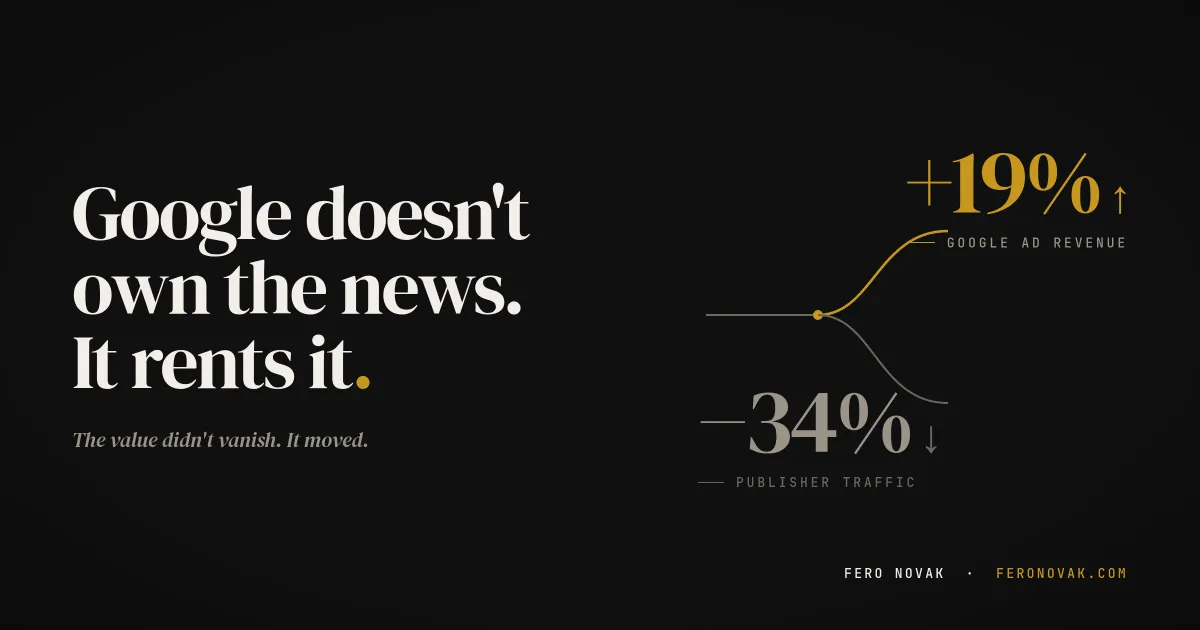
Google's search advertising revenue grew 19% last quarter, to more than 60 billion dollars. The part of its ad business that pays publishers, the Google Network, fell 4% in the same quarter. Read those two numbers together: Google is making more from search ads and paying the open web less. Ads now appear in about a quarter of AI Overviews, up from almost none a year ago. When an Overview shows up, the click-through rate on that page falls off a cliff, for the ads and the links below them alike, and Google's revenue went up anyway.
The clicks to publishers collapsed. Google's revenue rose. The value didn't disappear when the traffic did. It moved, from the publishers who produce the content to the platform that summarizes it. This isn't Google wrecking its own ad business. It's Google keeping the revenue while the open web gets a smaller and smaller share of it.
The one thing Google can't manufacture
There is a floor under all of this, and it's the part worth holding onto.
An AI answer is a summary, and a summary needs something to summarize: journalism Google didn't write, doesn't own, and mostly doesn't pay for. The whole apparatus runs on content produced by the people losing the traffic.
The licensing deals prove the content has a price. News Corp signed with OpenAI for up to $250 million over five years. Axel Springer for around $13 million a year. The Financial Times, Le Monde, the Associated Press, Vox, The Atlantic all signed too. But two things are true about those deals. Only the biggest publishers got them, and OpenAI has said plainly it does not plan to share advertising revenue with any of them. A flat fee is not a seat at the table. It's a buyout of the input.
Take the publishers out entirely, by blocking the crawlers, by paywalling, or by going under, and the answer engine is left summarizing its own guesses. Google doesn't own the news. It rents it, and right now the rent doesn't cover what the journalism costs to make.
The split that decides who survives
Back to those two numbers. Aktuality flat, lifestyle down two-thirds. The variable wasn't luck and it wasn't the algorithm. It was first-party demand.
Aktuality runs about half its traffic through Google, but over the last two years we built the things that bring a reader back without a search: a subscription base that more than doubled in its first year, newsletters, app notifications, a registered audience we can reach directly. When the front door narrowed, the people who already knew us were still there.
Our lifestyle title ran 60-70% on Google and Discover, with almost nothing direct behind it. When the channel weakened, there was nothing to fall back on. That audience was never really ours. We rented it from Google, and Google changed the terms.
You can see exactly how it changed, and it's worth seeing, because it kills the comforting idea that this is just readers losing interest. In the Discover feed alone, Google showed that title 56% less than a year earlier. Fewer impressions, not fewer fans. And the readers who still saw it clicked a little less often too, around 12% of the time instead of 16. Less visibility and a softer click rate, compounding into a two-thirds drop in clicks. Aktuality, on the same feed in the same year, kept its visibility and its click rate almost unchanged. Same algorithm, opposite treatment. The deciding variable wasn't the content. It was whether Google still had a reason to put us in front of people, and how much of our audience we could reach when it didn't.
The same split runs across the market. Slovak news brands held their audience nearly flat this year, while the whole tabloid category, ours and our competitors' alike, lost 15 to 20% of its total real users. The New York Times, years ahead on subscriptions, turned its search decline into a managed transition instead of a cliff. Publishers with a direct relationship to their readers are bending. The ones renting their audience from a platform are breaking.
And here is the number that actually moves me. Our Google traffic to that title fell by two-thirds. Its total audience fell by a third. The gap between those two numbers is direct traffic doing its job - readers who arrive through the homepage, the app and the newsletter, not a Google feed. Direct is what stopped a channel collapse from becoming an audience collapse. You can even watch the audience move: as the old rented surface fell away, a newer lifestyle surface we control went from almost no Google traffic to more than a hundredfold that in a year.
What we're actually doing
So we stopped optimizing for the front door.
The roadmap now is first-party: communities, newsletters, push notifications, the direct channels Google was never part of and can't insert itself into. An audience that comes to us on purpose is the one no algorithm can take back, and it's the only durable asset we have in this whole shift.
The second front is the one most publishers are still ignoring while they argue about blocking versus licensing. The AI layer sits between us and the reader now whether we like it or not. The question isn't whether to feed it. It's on whose terms. License the content, structure it so the machine reads what we choose it to, or withhold it, but decide on purpose, because the content is the leverage and most publishers are giving it away by accident.
Some of the industry is already building the means to do exactly that. A coalition called SPUR, the BBC, the Financial Times, the Guardian and more than thirty other publishers, mine among them, is putting together the technical standard that lets each of us see when an AI uses our journalism and charge for it. Not a cartel and not a collective license; everyone still cuts their own deals. It's the plumbing that turns content from something taken into something priced.
Google was the front door to the news. We own the building. The sooner the industry stops negotiating like the desperate party and starts acting like the supplier it is, the better the terms will get.
Sources
- Google search ad revenue up 19%, Network ad revenue down 4% (Q1 2026): Alphabet earnings (CNBC); ppc.land
- Zero-click ~60% and publisher referral decline: Press Gazette; Axios (Chartbeat)
- NYT search share and Daily Mail click-through: Press Gazette; Digiday
- Publisher search-traffic forecast (-43% in 3 years): Search Engine Land (Reuters Institute)
- AI Overview ad placements and click-through impact: Digital Applied; Ahrefs
- AI licensing deals and OpenAI's ad-revenue stance: Press Gazette (deals); Press Gazette (ad revenue)
- Ringier joins the SPUR publisher coalition (June 2026): Ringier