The five questions
I run a media company, so the question that reaches my desk is not "what does Article 50 say". It is "can we publish this piece without a label". The text answers that in one sentence, and the Commission's FAQ on Article 50 (last updated 24 July 2026) fills in what the words mean. I turned both into five questions you can ask of any piece, in order.
- Did AI generate or manipulate the text? Article 50(4) binds deployers of an AI system that "generates or manipulates text". If a model wrote or rewrote the substance, you are in. If it only checked spelling, the FAQ does not settle whether that counts as manipulation, and I would not build a process on a gap. For providers, Article 50(2) excludes systems that perform "an assistive function for standard editing" from the marking duty. That is a rule about the tool maker's marking, not a clearance for your label.
- Is it published to inform the public on a matter of public interest? The FAQ lists three criteria: the text is published, it informs the public, and it concerns public interest, with politics and public administration as examples. An internal summary fails the first test. A council budget story passes all three.
- Did a person examine the substance? The FAQ calls human review "the deliberate examination of the substance of the content" by people with relevant knowledge and professional judgement. It says plainly that "superficial, solely formal, or procedural checks (e.g. spell-checking or grammatical correction)" are not review or editorial control.
- Could an editor have changed or rejected it? Editorial control, in the FAQ's words, is exercised by a responsible editorial entity "having the authority to approve, alter or reject the substance of the text based on substantive grounds", including fact-checking and checking the trustworthiness of sources. A button that only approves is not that.
- Who holds editorial responsibility? The FAQ says this person "must hold the ultimate legal responsibility over the publication of the content". Article 50(4) allows a natural or legal person, so an organisation can hold it. Someone has to be named in advance, not after the complaint.
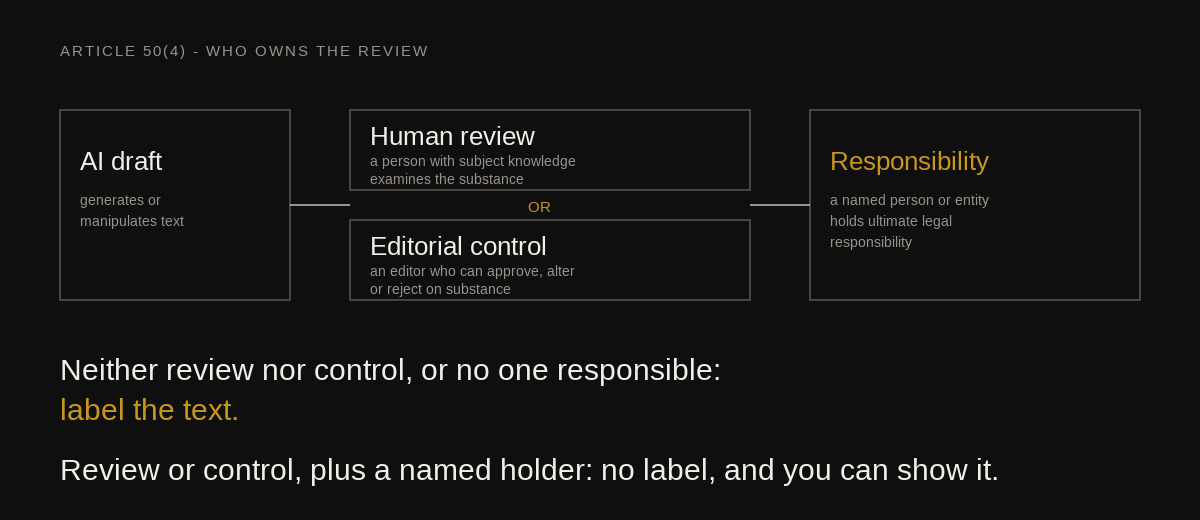
If question 1 and 2 are yes, the label is the default. Questions 3 to 5 are the exemption, and the text uses "and": review or control, plus responsibility. Fail both 3 and 4, or fail 5, and you label.
The law asks for review or control. I would require both, because a reviewer who cannot change the text only advises, and an editor who never examined the substance only signs.
The Commission's FAQ states no documentation requirement for the exemption. It does say that deployers who do not follow the voluntary Code of Practice must demonstrate compliance "through alternative adequate means". My reading: if you rely on the exemption, a record of who reviewed what and who signed off is how you demonstrate it. That is my inference, not the Commission's instruction.
The decision table
Five cases, each tested against the same questions. "Real review" means question 3 or 4 holds, and question 5 holds.
| Case | Published | Public interest | Real review | Outcome |
|---|---|---|---|---|
| AI-drafted explainer, reporter checks claims, editor can reject, publisher responsible | Yes | Yes | Yes | Exempt |
| AI-drafted report on a council vote, approved with one click | Yes | Yes | No | Label |
| Human-written piece, AI used for spell-check only | Yes | Yes | n/a | Open |
| AI-generated internal briefing | No | Yes | n/a | Not covered |
| Synthetic image or video of a real person | Yes | n/a | n/a | Other test |
The last row is a different part of Article 50(4), the one on deepfakes. It has its own exceptions for evidently artistic or satirical work, and this article does not cover it. "Open" means the text does not answer it. I would label while it is open, because a label costs a line and a wrong call costs a fine. The table is also in CSV form.
Two cases from a publisher's seat
These are constructed examples. They are not descriptions of any newsroom's current state.
Case 1: the budget vote. A model drafts a 300-word report from the council's published minutes. A duty editor reads it for tone, fixes a headline and publishes. Question 2 is yes: public administration. Question 3: the editor checked the writing, not the substance. Nobody compared the figures with the minutes. That is the superficial check the FAQ rules out, so the piece carries the label. The fix is a different order of work: the reporter checks every figure against the source before the editor sees it, and the editor can reject the piece on substance. Then the same text may qualify for the exemption.
Case 2: the energy-price explainer. A model produces a first structure and a draft. A reporter who covers the topic rewrites two sections, replaces three claims whose sources do not hold up, and adds a quote. The section editor has the authority to reject the piece and has done so before. The publishing company holds legal responsibility for everything on the site. Questions 3, 4 and 5 are yes, so the exemption applies if you can show it. What I would keep from this case: the reporter's changes are visible in the version history, and the section editor's sign-off sits in the CMS next to the piece. The record exists because the work happened first.
The label is one line of text. The exemption is staff time on substance, per piece. Anyone who tells you to skip the label should tell you who pays for that time.
When this does not apply to you
Article 50 splits duties by role. Providers, the companies that build the AI system, carry Article 50(1) and 50(2): telling people they talk to a machine, and marking synthetic output in a machine-readable way. Deployers carry 50(3) and 50(4). A publisher using someone else's model is a deployer for the text duty. A publisher that builds its own text-generation system can be both.
That is where 2 December 2026 comes in. Regulation (EU) 2026/1744, published in the Official Journal on 24 July 2026, gave providers of generative systems already on the market before 2 August 2026 until 2 December 2026 to comply with Article 50(2). It is a provider date. Article 111(4) names only 50(2), so it does not delay Article 50(4). When your tools start marking their output on 2 December, nothing changes in your own duty: a machine-readable mark does not replace the label or the review.
Also outside this test: AI-generated content that is not published, text used where the law authorises it to detect or prosecute crime, and anything that is not text, image, audio or video.
My position
I argued in May that the EU was finally regulating in the right order: build first, learn, then regulate what already shipped. Article 50(4) fits that. It does not tell a newsroom to stop using AI. It says that when the substance of a public-interest text came from a machine, either a reader is told or a person is accountable for it. I think that is a fair deal, and I would rather work under it than argue with it.
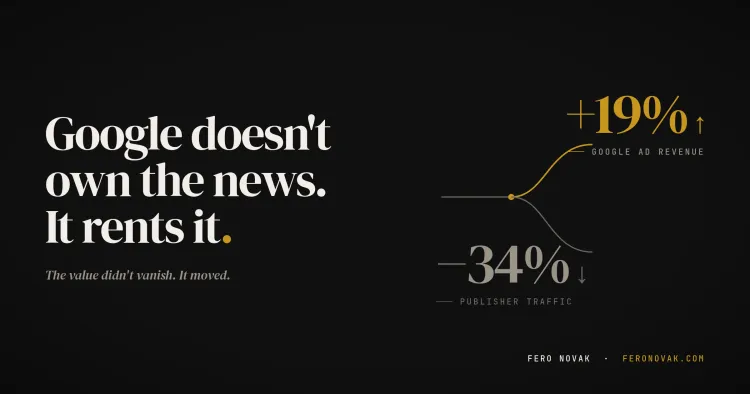
The exemption describes how a newsroom works. A publisher who can name the reviewer, the editor and the responsible entity for each AI-assisted piece has nothing to hide behind a label. A publisher who cannot is already labelling, whether it admits it or not. I wrote the same checklist in July as a LinkedIn post. Here it is with the sources attached. For the wider question of who benefits when AI rents the news, see Google doesn't own the news. It rents it.
Sources
- Regulation (EU) 2024/1689, Article 50 (applies from 2026-08-02): https://eur-lex.europa.eu/eli/reg/2024/1689/oj
- Regulation (EU) 2026/1744, Article 111(4), Official Journal 2026-07-24, in force 2026-07-27: https://eur-lex.europa.eu/eli/reg/2026/1744/oj
- Commission FAQ on Article 50 (last updated 2026-07-24): https://digital-strategy.ec.europa.eu/en/faqs/transparency-obligations-under-article-50-ai-act
- Commission, Code of Practice on marking and labelling AI-generated content: https://digital-strategy.ec.europa.eu/en/news/commission-publishes-code-practice-marking-and-labelling-ai-generated-content